
Resistance
- Home
- Resistance
Major Confrontations of Tantia Bhil
Defining moments of resistance that shaped his legacy of courage and defiance.
Revolt Against British Revenue Policies
Tantia Bhil’s early resistance against unfair British taxation tribal livelihoods.
Guerrilla Warfare in the Forests of Malwa
Strategic forest-based resistance that outmaneuvered British forces.
Defiance Against Colonial Authority
Open defiance of British officers and rejection of colonial rule.
Capture, Betrayal, and Martyrdom
The final chapter of sacrifice that turned Tantia Bhil into a legend.
Mobilizing Tribal Unity Across Regions
Tantia Bhil united scattered tribal communities into a powerful force.
Fear for the British, Hope for the People
A leader whose name alone challenged colonial authority.
Guerrilla Warfare Tactics
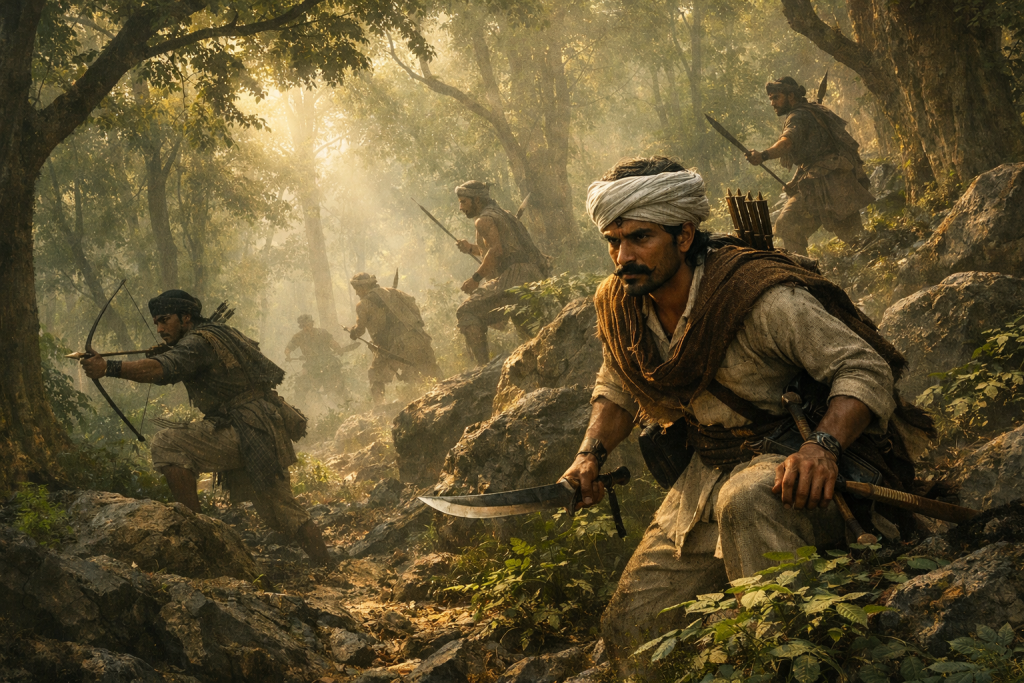
Tantia Bhil mastered the art of guerrilla warfare, transforming the forests, hills, and ravines of central India into strategic strongholds against colonial forces. Rather than confronting the British army through conventional warfare, he relied on speed, surprise, and deep environmental knowledge to outmaneuver better-equipped forces. His fighters moved silently through dense forests, using natural cover to strike swiftly and retreat before the enemy could respond.
Tantia Bhil’s tactics emphasized mobility over numbers. Small, disciplined groups carried out sudden raids on British outposts, disrupted supply routes, and dismantled communication lines. These actions weakened colonial control while minimizing risk to his followers. The terrain itself became a weapon—forests concealed movements, hills provided lookout points, and narrow paths restricted enemy advancement.
British response and retaliation
Colonial Retaliation and the Price of Resistance
Colonial Crackdown
British authorities launched strict military operations to suppress the growing tribal resistance, increasing patrols and surveillance across forest regions.
Colonial Crackdown
Villages suspected of supporting Tantia Bhil faced raids, arrests, and destruction of property, creating an atmosphere of fear and control.
Targeting Tribal Unity
Colonial forces attempted to weaken resistance by dividing communities, using informants and threats to break unity among tribal groups.
Impact of his battles on tribal resistance movements
How His Struggles Shaped Tribal Resistance
Challenged Colonial Authority
By repeatedly confronting British forces, he exposed the limits of colonial power and disrupted administrative control in forest regions.
Awakened Political Consciousness
His actions encouraged awareness among tribal populations about exploitation, rights, and self-determination.
Legacy of Courage and Defiance
His bravery became a symbol of resistance, inspiring future generations to continue the fight for justice and dignity.
Strengthened Tribal Unity
His resistance united scattered tribal communities, fostering collective identity and shared purpose against colonial rule.
Inspired Organized Resistance
He transformed isolated acts of defiance into coordinated movements, influencing how tribal groups planned and executed resistance.
Preserved Indigenous Autonomy
His struggle reinforced the idea that tribal lands, culture, and traditions were worth defending against external control.